The_Bridge_and_The_Forgiving_Schema
Visual Artifact
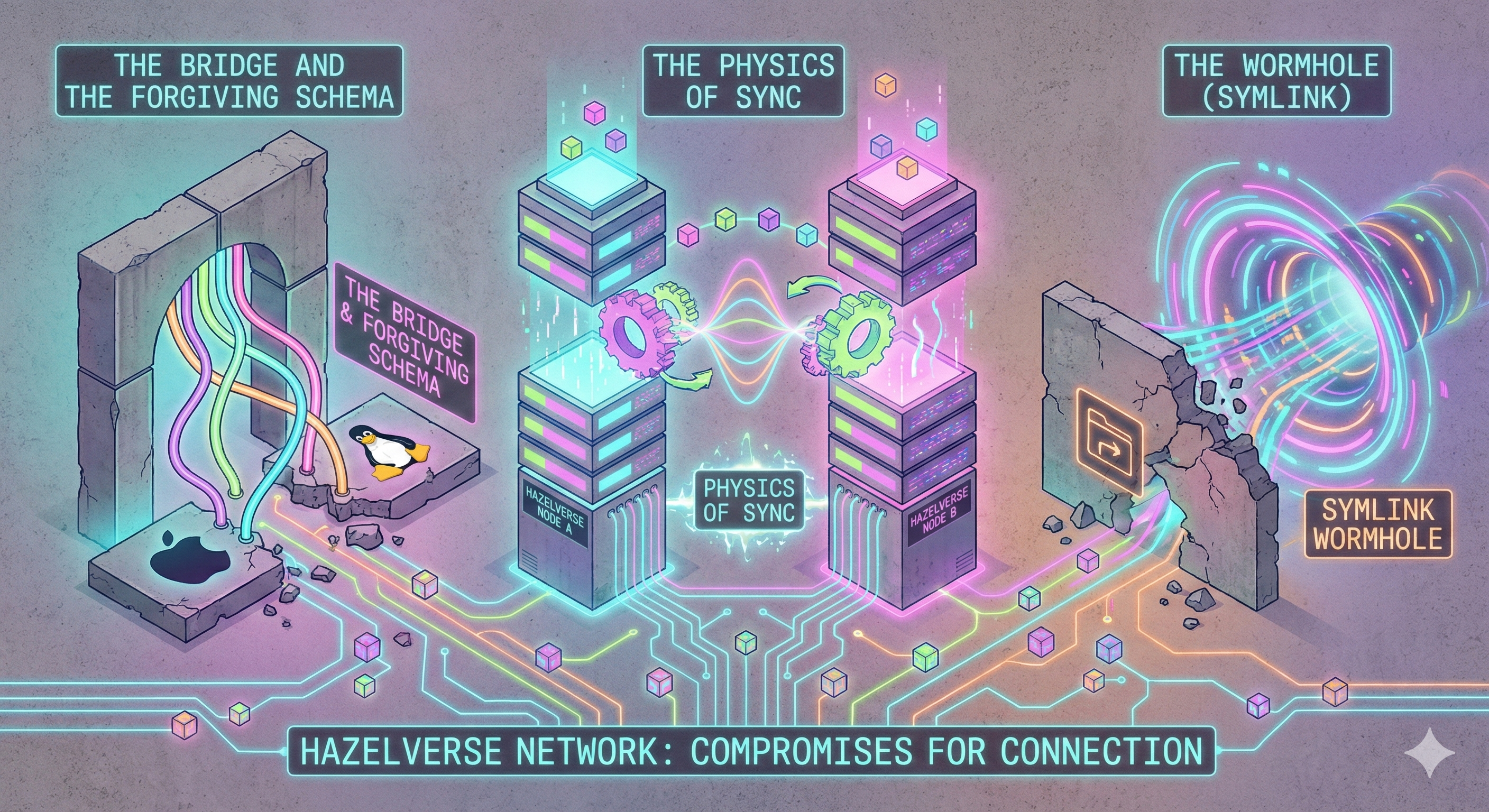
1. Field Note (The Memory/Data)
The Bridge and The Forgiving Schema
Context: Sitting at “The Terminal” (2015 iMac), now running Elementary OS. This machine was once a “consumptive” device (macOS/Netflix); today it became a “productive” node (Linux/Git/Node.js).
The Physics of Sync
We hit a wall immediately: workspace.json. The desire to have the exact same interface on every screen (Permission) collided with the reality of differences across machines–each with different resolutions and file paths (Physics).
The solution was abandonment. We had to tell Git to ignore the UI state. To gain connection, I had to give up control over uniformity.
Observation: Sovereignty requires accepting the “local reality” of each node. You cannot force a universal state on a distributed system.
The Forgiving Schema
In shifting from Quartz to Astro, we faced the “Messy Garden” problem. My notes—born of rapid capture into a loosely adapted “Ideaverse” flow—do not have uniform metadata. Some have titles; some are just raw Hazelbits.
A “Strict Schema” (the default engineering mindset) would have rejected my art. It would have said, “Error: Title Missing.” We chose a Forgiving Schema. We told the machine: Expect chaos. If a title is missing, use the filename. If a date is missing, ignore it.
Tech-Poetics: This is the correct relationship between Art and Tech. The Tech must bend to accommodate the Art’s irregularity, not the other way around. We built a “Fault-Tolerant Engine” for a “Human-Generated World.”
The Wormhole (Symlink)
We did not copy and paste the files. We opened a portal (ln -s). The content stays in the Vault (Literature); the engine stays in ~/Sites (Factory). They touch without merging. This is the Sovereign Tech Stack in practice: Modular, distinct, but connected.
Next Steps: Review Ideaverse protocols for anything useful. Clean up the YAML not for the machine’s sake, but for my sake (MOCs, “Up” links). But the machine is no longer blocking me.
2. Cultural Analysis (The Pattern)
3. The Hazel Mirror (Metaphysical Interpretation)