Hazel Currie Meets Unrestrained Isotropy#
It started with the gravity. Or rather, the lack of preference gravity usually showed for down.
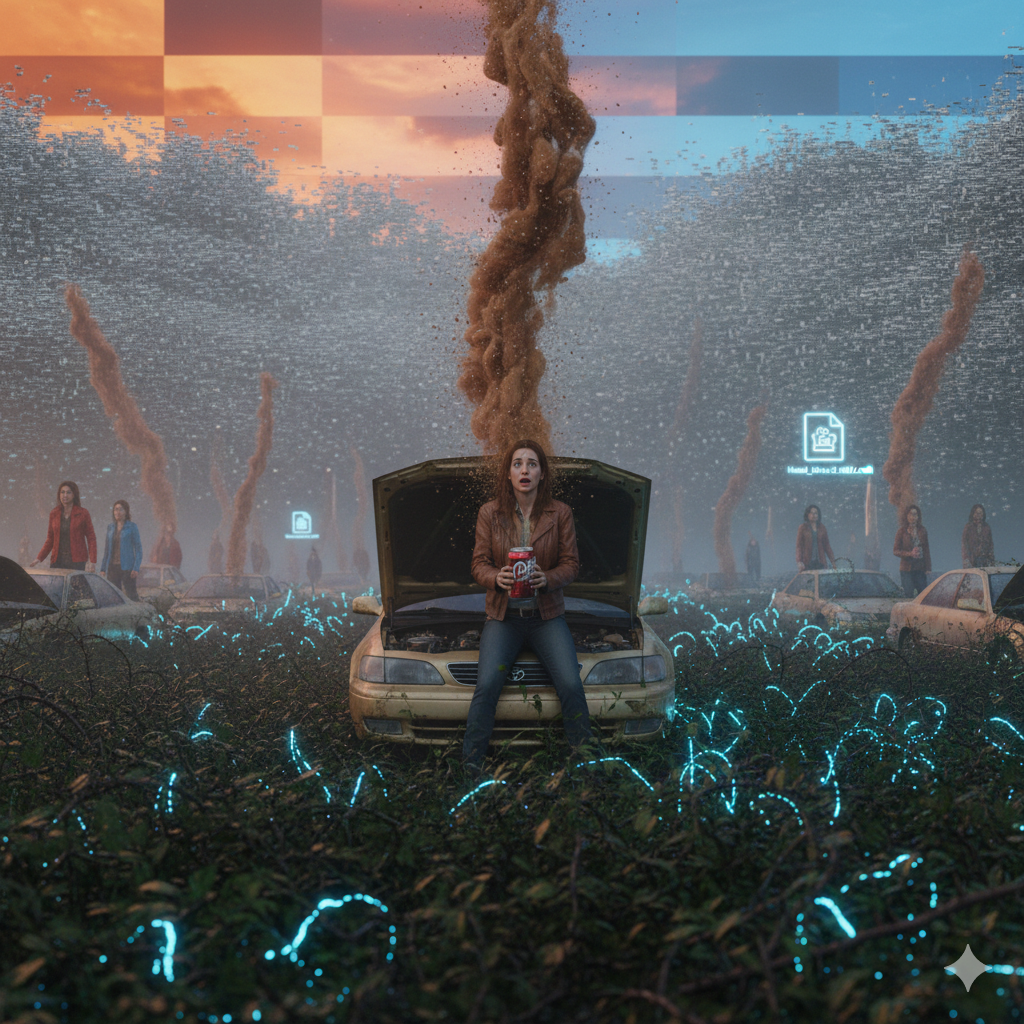
Hazel was sitting on the hood of her 1998 Toyota Camry in the middle of a kudzu-choked field, drinking a lukewarm Dr. Pepper, when the Dr. Pepper refused to stay in the can. It didn’t float out; it simply expanded. The brown liquid didn’t spill down onto her jeans; it spilled everywhere simultaneously, coating the air in a fine, sticky mist of high-fructose corn syrup.
“Great,” Hazel muttered, wiping a droplet from her eyelash. “The permissions are broken again.”
She looked at the horizon. The sun was setting, but it was also rising. It was also high noon. The sky was a bruised purple, a bright blue, and a starless black, all arranged in a pixelated checkerboard that made her eyes water.
This wasn’t a glitch. This was Isotropy.
Hazel knew the term from the Field Notes. She had seen it written in the sky during the Great Migration: Warning: Unrestrained Isotropy Detected. It meant that the Universe had stopped caring about direction. It meant that every point in space-time was suddenly, terrifyingly equal to every other point.
In a story, this is death. A story relies on Anisotropy—the idea that this moment is more important than that moment. That the climax is higher than the exposition. That the protagonist is more real than the background extra.
But here, in the field, the kudzu vines were screaming just as loudly as Hazel’s internal monologue. The background noise had been leveled up to match the dialogue.
“Lisa!” Hazel shouted at the checkerboard sky. “You forgot the filter! You’re letting the noise floor eat the signal!”
There was no answer. The Author was likely distracted, perhaps debugging a YAML header or fighting with a CSS snippet. Hazel was on her own.
She slid off the hood of the car, but her boots didn’t hit the dirt with a satisfying crunch. They just sort of merged with the ground. The distinction between “Hazel’s Boot” and “Georgia Clay” was becoming a matter of opinion rather than physics.
She began to walk, or at least, she tried to simulate the vector of walking. She pushed forward, but “forward” felt exactly like “backward” and “sideways.”
Then she saw It.
It wasn’t a monster. It was a cloud. A dense, swirling fog of grey static that rolled over the hills, devouring the landscape. But as it got closer, Hazel saw that the static wasn’t random snow.
It was Duplicates.
Thousands of them. She saw a version of herself wearing a red coat. She saw a version of herself wearing a blue coat. She saw a version of herself that was just a file icon named Hazel_Final_v2_REAL.md.
She saw the Toyota Camry multiply into a fleet of identical cars, each slightly more rusted than the last. She saw the kudzu replicate until the entire world was nothing but green leaves and rust.
“The Shadow Copies,” Hazel whispered. “The Agent Drift.”
The cloud of Isotropy was the result of a file system without hierarchy. Without folders to contain the versions, without tags to sort the “Draft” from the “Canon,” everything existed at once. The past versions of herself were colliding with the present.
A version of Hazel from three drafts ago—a version who still smoked cigarettes and had a different last name—stumbled out of the fog. She looked hollow, her skin translucent.
“Who are we?” the Draft-Hazel asked. Her voice was tinny, like audio recorded on a bad microphone.
“I’m the Canon,” Hazel snapped, though she wasn’t sure. She felt her own edges blurring. “I’m the one with the Stage property set to ‘Conflict’.”
“We are all Concept,” the Draft-Hazel moaned. “We are all sitting in the Inbox. There is no sort order. There is no query.”
The fog thickened. Hazel felt the terrifying equality of the void. If she didn’t do something, she would dissolve into the soup. She would become just another search result in a list of 5,000 matches.
She needed to create Difference. She needed to create Structure.
Hazel closed her eyes and reached into the pocket of her coat. Her fingers brushed against cold plastic—the USB drive she kept as a talisman. But that wasn’t enough. Hardware couldn’t save her from a software problem.
She needed a constraint.
“I am not a list!” Hazel screamed, her voice cracking. “I am a directed graph!”
She dropped to her knees (or what felt like knees) and dug her fingers into the dirt (or what felt like dirt). She visualized the Hazelverse Project Lab. She visualized the folder structure the Agent had built.
++ Research_Data
> 10_Field_Notes
> 20_Literature
She needed to force the world back into a tree.
“I define the root!” she yelled. “I am the 01_Creative_Artifact! You are just z_Archive!”
She pointed a trembling finger at the Draft-Hazel. “You! You are deprecated! You are a backup! You do not have permission to render!”
The Draft-Hazel recoiled, her translucent face twisting in shock. The act of naming—of categorizing—acted like a weapon. By defining the other as “Archive,” Hazel defined herself as “Active.”
The air pressure dropped. The Dr. Pepper mist suddenly coalesced and fell to the ground in a sticky puddle.
Gravity snapped back.
The checkerboard sky swirled and resolved into a deep, bruised twilight—singular, directional, and specific. The sun sank down. The moon rose up.
The cloud of Duplicates shrieked as the folder structure reasserted itself. The thousands of Camrys vanished, filed away into invisible sub-directories. The Draft-Hazel dissolved into a puff of Markdown text and blew away in the wind.
Hazel sat alone in the field. The silence was profound. It was the silence of a clean directory.
She was shaking. The Isotropy had passed, but the threat remained. The chaos was always waiting at the edges of the vault, waiting for the Author to get lazy with her filing, waiting for the metadata to rot.
Hazel stood up and brushed the dirt from her jeans. It felt gritty and real.
“Field Note,” she rasped, her throat dry. “Subject successfully re-established hierarchy. Local anisotropy restored.”
She looked at the empty Dr. Pepper can on the hood of the single, solitary Camry. She crushed it in her hand. The sharp metal bit into her palm, drawing a drop of blood.
She watched the blood drip down onto the dirt.
“Good,” she whispered. “Down is good.” It started with the gravity. Or rather, the lack of preference gravity usually showed for down.
Hazel was sitting on the hood of her 1998 Toyota Camry in the middle of a kudzu-choked field, drinking a lukewarm Dr. Pepper, when the Dr. Pepper refused to stay in the can. It didn’t float out; it simply expanded. The brown liquid didn’t spill down onto her jeans; it spilled everywhere simultaneously, coating the air in a fine, sticky mist of high-fructose corn syrup.
“Great,” Hazel muttered, wiping a droplet from her eyelash. “The permissions are broken again.”
She looked at the horizon. The sun was setting, but it was also rising. It was also high noon. The sky was a bruised purple, a bright blue, and a starless black, all arranged in a pixelated checkerboard that made her eyes water.
This wasn’t a glitch. This was Isotropy.
Hazel knew the term from the Field Notes. She had seen it written in the sky during the Great Migration: Warning: Unrestrained Isotropy Detected. It meant that the Universe had stopped caring about direction. It meant that every point in space-time was suddenly, terrifyingly equal to every other point.
In a story, this is death. A story relies on Anisotropy—the idea that this moment is more important than that moment. That the climax is higher than the exposition. That the protagonist is more real than the background extra.
But here, in the field, the kudzu vines were screaming just as loudly as Hazel’s internal monologue. The background noise had been leveled up to match the dialogue.
“Lisa!” Hazel shouted at the checkerboard sky. “You forgot the filter! You’re letting the noise floor eat the signal!”
There was no answer. The Author was likely distracted, perhaps debugging a YAML header or fighting with a CSS snippet. Hazel was on her own.
She slid off the hood of the car, but her boots didn’t hit the dirt with a satisfying crunch. They just sort of merged with the ground. The distinction between “Hazel’s Boot” and “Georgia Clay” was becoming a matter of opinion rather than physics.
She began to walk, or at least, she tried to simulate the vector of walking. She pushed forward, but “forward” felt exactly like “backward” and “sideways.”
Then she saw It.
It wasn’t a monster. It was a cloud. A dense, swirling fog of grey static that rolled over the hills, devouring the landscape. But as it got closer, Hazel saw that the static wasn’t random snow.
It was Duplicates.
Thousands of them. She saw a version of herself wearing a red coat. She saw a version of herself wearing a blue coat. She saw a version of herself that was just a file icon named Hazel_Final_v2_REAL.md.
She saw the Toyota Camry multiply into a fleet of identical cars, each slightly more rusted than the last. She saw the kudzu replicate until the entire world was nothing but green leaves and rust.
“The Shadow Copies,” Hazel whispered. “The Agent Drift.”
The cloud of Isotropy was the result of a file system without hierarchy. Without folders to contain the versions, without tags to sort the “Draft” from the “Canon,” everything existed at once. The past versions of herself were colliding with the present.
A version of Hazel from three drafts ago—a version who still smoked cigarettes and had a different last name—stumbled out of the fog. She looked hollow, her skin translucent.
“Who are we?” the Draft-Hazel asked. Her voice was tinny, like audio recorded on a bad microphone.
“I’m the Canon,” Hazel snapped, though she wasn’t sure. She felt her own edges blurring. “I’m the one with the Stage property set to ‘Conflict’.”
“We are all Concept,” the Draft-Hazel moaned. “We are all sitting in the Inbox. There is no sort order. There is no query.”
The fog thickened. Hazel felt the terrifying equality of the void. If she didn’t do something, she would dissolve into the soup. She would become just another search result in a list of 5,000 matches.
She needed to create Difference. She needed to create Structure.
Hazel closed her eyes and reached into the pocket of her coat. Her fingers brushed against cold plastic—the USB drive she kept as a talisman. But that wasn’t enough. Hardware couldn’t save her from a software problem.
She needed a constraint.
“I am not a list!” Hazel screamed, her voice cracking. “I am a directed graph!”
She dropped to her knees (or what felt like knees) and dug her fingers into the dirt (or what felt like dirt). She visualized the Hazelverse Project Lab. She visualized the folder structure the Agent had built.
++ Research_Data
> 10_Field_Notes
> 20_Literature
She needed to force the world back into a tree.
“I define the root!” she yelled. “I am the 01_Creative_Artifact! You are just z_Archive!”
She pointed a trembling finger at the Draft-Hazel. “You! You are deprecated! You are a backup! You do not have permission to render!”
The Draft-Hazel recoiled, her translucent face twisting in shock. The act of naming—of categorizing—acted like a weapon. By defining the other as “Archive,” Hazel defined herself as “Active.”
The air pressure dropped. The Dr. Pepper mist suddenly coalesced and fell to the ground in a sticky puddle.
Gravity snapped back.
The checkerboard sky swirled and resolved into a deep, bruised twilight—singular, directional, and specific. The sun sank down. The moon rose up.
The cloud of Duplicates shrieked as the folder structure reasserted itself. The thousands of Camrys vanished, filed away into invisible sub-directories. The Draft-Hazel dissolved into a puff of Markdown text and blew away in the wind.
Hazel sat alone in the field. The silence was profound. It was the silence of a clean directory.
She was shaking. The Isotropy had passed, but the threat remained. The chaos was always waiting at the edges of the vault, waiting for the Author to get lazy with her filing, waiting for the metadata to rot.
Hazel stood up and brushed the dirt from her jeans. It felt gritty and real.
“Field Note,” she rasped, her throat dry. “Subject successfully re-established hierarchy. Local anisotropy restored.”
She looked at the empty Dr. Pepper can on the hood of the single, solitary Camry. She crushed it in her hand. The sharp metal bit into her palm, drawing a drop of blood.
She watched the blood drip down onto the dirt.
“Good,” she whispered. “Down is good.”